- Written by: Admin
- September 4, 2026
- Categories: Exam, Students, Teachers
- Tags: , child needs mindfulness India, how do I know if my child needs yoga, signs of stress in children yoga, yoga for stressed children
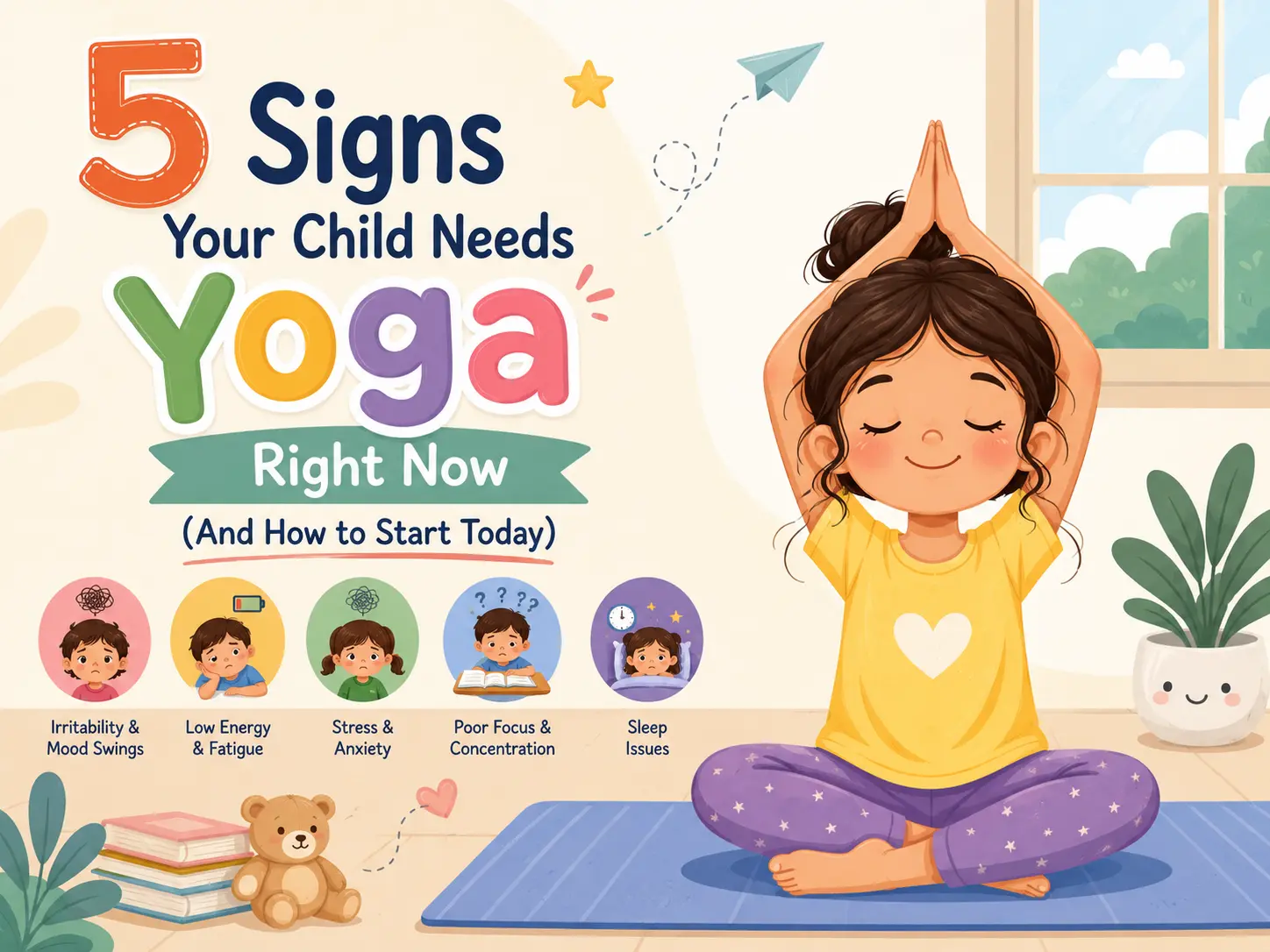
5 Signs Your Child Needs Yoga Right Now (And How to Start Today)
Every child has difficult days. But some children have difficulties every day.
Meltdowns that come from nowhere. Nights where sleep just will not come. A body that cannot sit still no matter how much you ask.
These are not just phases. And they are not bad behaviors.
They are signs. Signs that your child’s nervous system is overwhelmed. And signs that yoga could change everything.
Here are 5 clear signs your child needs yoga right now. And exactly how to start today.
Sign 1 — Frequent Meltdowns or Big Emotional Outbursts
Does your child go from calm to overwhelmed in seconds?
Big emotional reactions are often signs that a child has not yet learned to regulate their nervous system. So when feelings get big, they spill over.
Yoga gives children real tools. Breathing exercises teach them to pause before reacting. Calming poses give their body somewhere to go when emotions feel too large. And consistent practice builds emotional regulation skills that carry into every part of life.
For breathing tools your child can use at the moment, read our blog Simple Breathing Exercises for Kids to Improve Focus and Sleep.
Sign 2 — Trouble Falling Asleep or Waking at Night
Does bedtime take forever? Does your child lie awake worrying?
Poor sleep in children is often driven by an overactive nervous system. So the body stays on high alert even when the day is done.
Evening yoga directly addresses this. Gentle poses calm the nervous system. Slow breathing signals to the body that it is safe to rest. Moreover, children who practice yoga regularly fall asleep faster and wake less often.
The guided bedtime stories inside our Jungle Yoga Trail course settle children into peaceful sleep naturally. So it is one of the most powerful bedtime tools available for parents.
Sign 3 — Cannot Sit Still or Focus for More Than a Few Minutes
Does your child struggle to concentrate on homework or any task requiring attention?
This is one of the most common challenges parents face right now. And it is not a character flaw. It is a body that needs to move before it can settle.
Yoga meets this need perfectly. It gives children a physical outlet for restless energy. And then — through breathwork and stillness — it trains the nervous system to focus.
For more on how yoga supports brain development and focus, read our blog Benefits of Yoga for Kids Brain Development and Concentration.
Sign 4 — Frequent Tummy Aches or Headaches With No Medical Cause
Does your child complain of stomach pain before school or headaches that come and go?
When doctors find nothing physically wrong, these symptoms are often the body’s way of expressing stress. Children do not always have words for overwhelm. So it shows up physically instead.
Yoga helps in two ways. First, it lowers cortisol — the stress hormone that drives physical symptoms. Second, it teaches children to notice and name how they feel in their body.
Our Yoga Explorers course uses breathwork and calming stories to build exactly this kind of mind-body awareness in children aged 3 to 8.
Sign 5 — Excessive Worry, Clinginess, or Fear of New Situations
Does your child resist going to school? Worry about things that seem small? Cling to you in new situations?
Anxiety in children often looks like avoidance and excessive worry. And it is far more common than most parents realise.
Yoga builds confidence from the inside out. Warrior Pose and Star Pose teach children to feel strong and brave in their bodies. Breathwork gives them a tool to calm themselves anywhere. And consistent practice builds resilience that makes new situations feel manageable — not terrifying.
For more on how yoga specifically helps anxious children, read our blog 5 Yoga Poses for Anxious Kids: Calm Meltdowns Naturally.
How to Start Today — Even If You Know Nothing About Yoga
You do not need experience. You do not need equipment. And you do not need a lot of time.
Here is the simplest way to begin right now.
Step 1 — Find 10 minutes before bed or after school. Step 2 — Sit with your child and take 5 slow deep breaths together. Step 3 — Try 3 animal poses — Cat, Frog, and Star. Make sounds. Be silly. Laugh. Step 4 — End with Belly Breathing — lie down, place a toy on the tummy, breathe it up and down 5 times.
That is enough to begin.
For a fully guided programme your child can follow independently, explore our online courses. The Jungle Yoga Trail is perfect for ages 4 to 8. It uses jungle adventures and original music to make every session genuinely exciting. The Yoga Explorers and Yoga Adventureland build on this with global adventures and alphabet learning. All three include lifetime access and a certificate of completion.
For screen-free practice at home, our Yoga Flashcards let children pick their own poses independently. And our Mindful Me Poster Pack adds visual affirmations that reinforce positive feelings throughout the day.
Not sure where to start? Explore our Free Resources first. Or join our Online Yoga Classes for Kids for live expert-led sessions for ages 4 to 12.
Conclusion
Children cannot always tell us when they are struggling. But their behaviour always does.
If you recognise your child in any of these 5 signs — that is all you need. Start today. Even 10 minutes makes a real difference.
Frequently Asked Questions
Q1. How do I know if my child needs yoga?
The most common signs are frequent meltdowns, trouble sleeping, inability to focus, unexplained tummy aches, and excessive worry. These are signs that a child’s nervous system needs support. And yoga through movement, breathing, and calm is one of the most effective natural tools available.
Q2. What age can children start yoga for emotional wellbeing?
Children can start as early as age 2 to 3 with simple poses and breathing games. From age 4, structured yoga programmes like Yoga Guppy’s courses are ideal. The earlier you start, the stronger the emotional foundation your child builds.
Q3. How quickly does yoga help with children's stress and anxiety?
Many children feel calmer after a single session — especially with breathwork. But lasting improvements in emotional regulation and sleep typically develop over 3 to 4 weeks of consistent daily practice.
Q4. Can yoga replace therapy for an anxious child?
Yoga is a powerful complementary tool but not a replacement for professional support. If your child’s anxiety significantly affects daily life, consult a child psychologist or paediatrician alongside building a yoga practice.
Q5. Which Yoga Guppy course is best for an anxious or stressed child?
The Jungle Yoga Trail is the best starting point for ages 4 to 8. It uses adventure stories, original music, and animal poses to make yoga feel safe and fun — exactly what an anxious child needs. It includes lifetime access and a certificate of completion.