- Written by: Admin
- July 29, 2026
- Categories: School, Students, Teachers
- Tags: , classroom yoga activities for teachers, kids yoga school activities, mindfulness activities classroom India, yoga for kids focus school
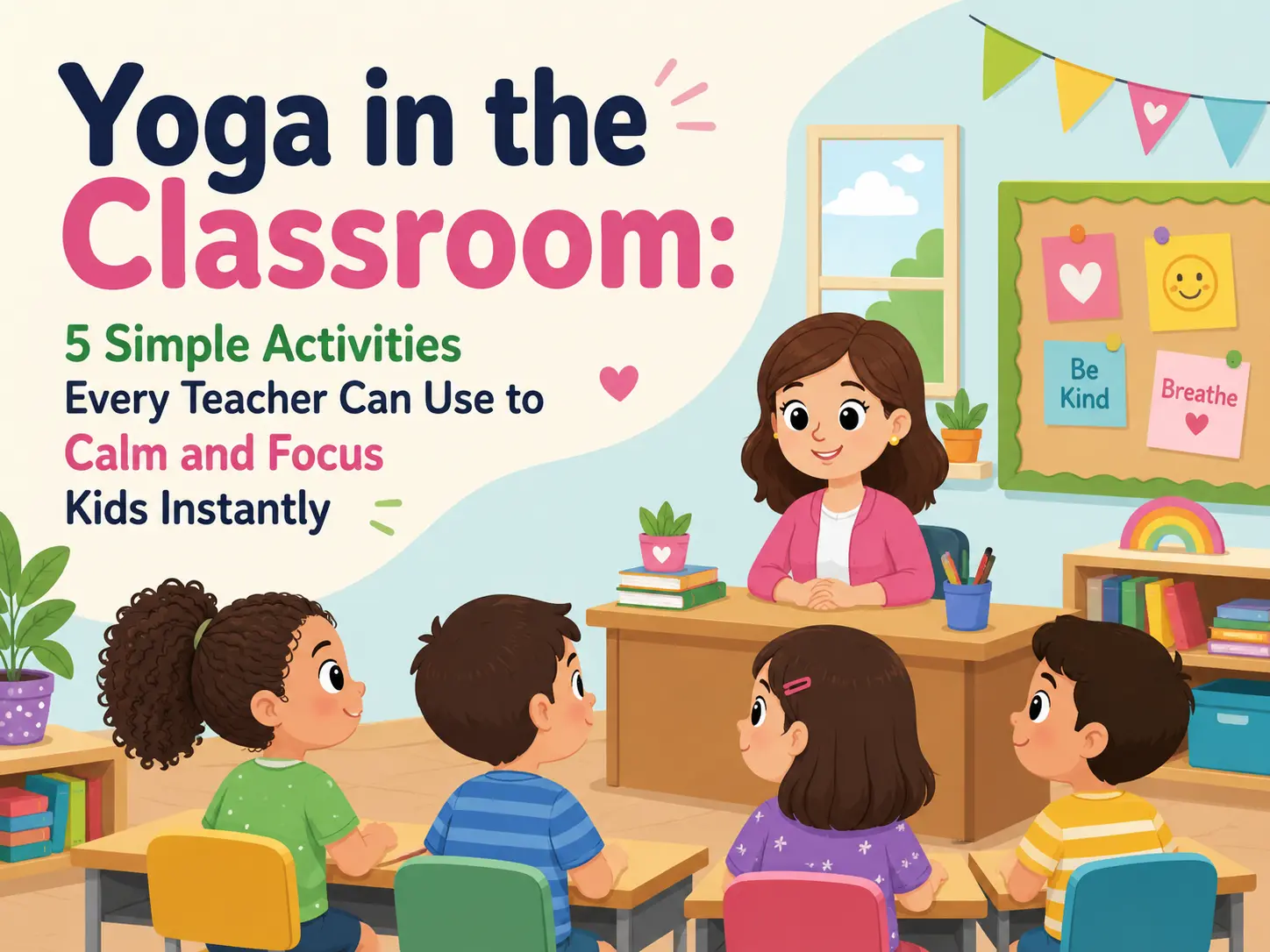
Yoga in the Classroom: 5 Simple Activities Every Teacher Can Use to Calm and Focus Kids Instantly
You do not need a yoga mat. You do not need training. You do not need to clear the classroom furniture or change the timetable.
What you need is five minutes — and the five activities in this guide. Teachers across India and around the world are using exactly these tools between lessons, after lunch, before exams, and at any moment when the energy in the room feels scattered, restless, or overwhelmed.
The results are real. Calmer behaviour. Sharper focus. Fewer interruptions. And children who genuinely enjoy the transition.
Why Classroom Yoga Works
Children’s brains are not designed to sit still and concentrate for hours at a stretch. When attention and energy drop — which happens predictably across the school day — behaviour deteriorates, learning slows, and both students and teachers feel the strain.
Yoga works in classrooms because it addresses this at the physiological level. Slow breathing activates the parasympathetic nervous system, reducing stress hormones and restoring the calm, alert state that learning requires. Movement releases physical tension that builds from prolonged sitting. And the combination of breath, body, and focus trains self-regulation skills that transfer into academic performance, social behaviour, and emotional resilience.
For the research behind how yoga specifically supports children’s focus and school performance, our blog How Yoga Helps Kids Focus Better in School gives a detailed parent and teacher-friendly breakdown.
5 Classroom Yoga Activities — No Experience Required
All five activities can be done in school uniforms, at desks or in a small open space, in under five minutes each.
1. Balloon Breathing — The Instant Calm Reset (1 minute)
Ask children to sit up straight and place both hands on their belly. Instruct them to breathe in slowly through the nose and imagine blowing up a big balloon in their tummy — watch it rise. Then breathe out slowly through the mouth and feel the balloon deflate. Repeat five times together.
This single exercise — done consistently before a lesson or after a break — produces measurable improvements in attention and reduces anxiety-driven restlessness within days. It is the foundation of every breathing practice at Yoga Guppy and the starting point for all structured mindfulness work with children.
For more breathing tools children love, our blog Simple Breathing Exercises for Kids to Improve Focus and Sleep gives teachers and parents a complete toolkit of breath games by age group.
2. Desk Warrior — Focus and Posture Reset (2 minutes)
From their chair, children sit tall and extend one arm forward like a warrior’s sword — fingers together, arm strong and straight. Hold for five slow breaths, focusing the gaze on one still point ahead. Switch arms. Follow with both arms extended like aeroplane wings, breathing deeply for five counts.
This seated strength pose activates the body, improves posture after prolonged sitting, and — crucially — asks children to hold their focus on a single point, which directly trains the concentration needed for classwork.
3. The Shaking Tree — Energy and Tension Release (1 minute)
Ask children to stand behind their chairs. Starting from the feet, begin shaking the entire body — ankles, knees, hips, arms, hands — as if they are a tree in a storm. After 30 seconds of full-body shaking, stop suddenly and stand completely still. Notice the tingling, warmth, and calm.
This is one of the most effective transitions between high-energy break time and focused lesson time. The contrast between vigorous movement and sudden stillness resets the nervous system remarkably quickly — children find it genuinely funny, which itself releases tension.
4. Mountain Pose Intention — Before a Test or Difficult Lesson (1 minute)
Children stand tall behind their chairs — feet together, arms by their sides, eyes closed. Three slow breaths together. Then, in their minds, they set one word for the session: calm, focus, brave, or strong. Open eyes and sit down.
This 60-second ritual takes nothing from lesson time but gives children a sense of self-regulation and readiness that noticeably affects how they approach challenging work. It is particularly powerful before examinations or presentations.
5. Star Pose Power — Confidence and Positivity Boost (1 minute)
Children stand in a space — beside their desk or in a small circle — and spread their feet wide and arms out into a big star shape. Big breath in, stretch wider. Big breath out, hold the shape. Five breaths. This open, expansive posture genuinely affects mood and confidence — children feel braver and more positive within moments of holding it.
Use this before public speaking, after a difficult moment, or whenever the classroom energy feels flat or discouraged.
Building a Consistent Practice in Your School
Individual activities work well as daily resets. But the most significant and lasting benefits for children — improved emotional regulation, sustained focus, and genuine resilience — come from a structured, consistent practice that builds progressively over weeks and months.
Yoga Guppy’s School Yoga Curriculum and Live Classes are designed specifically for this — bringing expert-led, story-based yoga into your school as a structured programme for ages 4 to 12, with sessions available for Little Yogis (4–6), Yoga Adventures (7–9), and Yoga for Tweens (10–12).
For teachers who want classroom-ready tools that children can lead themselves, our Yoga Flashcards and Let’s Play Yoga — Creative Games for Classrooms are used by teachers across India and internationally — giving children a visual, screen-free way to pick and practice poses independently between lessons.
And for schools exploring a full digital yoga programme with lifetime access for students, our three story-led online courses — The Jungle Yoga Trail, The Yoga Explorers, and The Yoga Adventureland — are the most complete kids yoga programmes available online for ages 4 to 12.
Conclusion
You do not need to become a yoga teacher to bring these benefits into your classroom. You need five minutes and the willingness to try one activity tomorrow morning.
Start with Balloon Breathing before your first lesson. Watch what happens to the room. Then explore the rest.
Your students are ready for it. They just need someone to begin.
Frequently Asked Questions
Q1. Do teachers need yoga training to use classroom yoga activities?
No training is needed for the five activities in this guide. They are designed to be immediately accessible to any teacher — delivered in school uniform, at desks or in a small open space, with no equipment required.
Q2. How long does classroom yoga take?
Each activity takes between one and two minutes. The full five-activity sequence can be completed in under ten minutes. Most teachers use one or two activities as transitions between lessons or after break time.
Q3. What age group do these classroom yoga activities suit?
All five activities work across ages 4 to 12 with minor adjustments for developmental stages. Younger children (4–6) respond best to the story-based framing — “shaking tree,” “balloon,” “mountain.” Older children (10–12) engage more with the intention-setting and posture elements.
Q4. Is there a structured yoga programme available for schools?
Yes. Yoga Guppy offers live, expert-led online yoga classes for schools split by age group (4–6, 7–9, 10–12), a full school yoga curriculum, and classroom-ready tools including yoga flashcards and the Let’s Play Yoga games book. Visit our Online Classes page to request a session.
Q5. How quickly do children respond to classroom yoga?
Most teachers notice a calmer, more focused classroom within the first week of consistent daily use — particularly with breathing activities. More significant improvements in emotional regulation and sustained attention build over four to six weeks of regular practice.