- Written by: Admin
- July 16, 2026
- Categories: Education
- Tags: , focus and attention, kids yoga, mindfulness for kids, online yoga classes, screen time
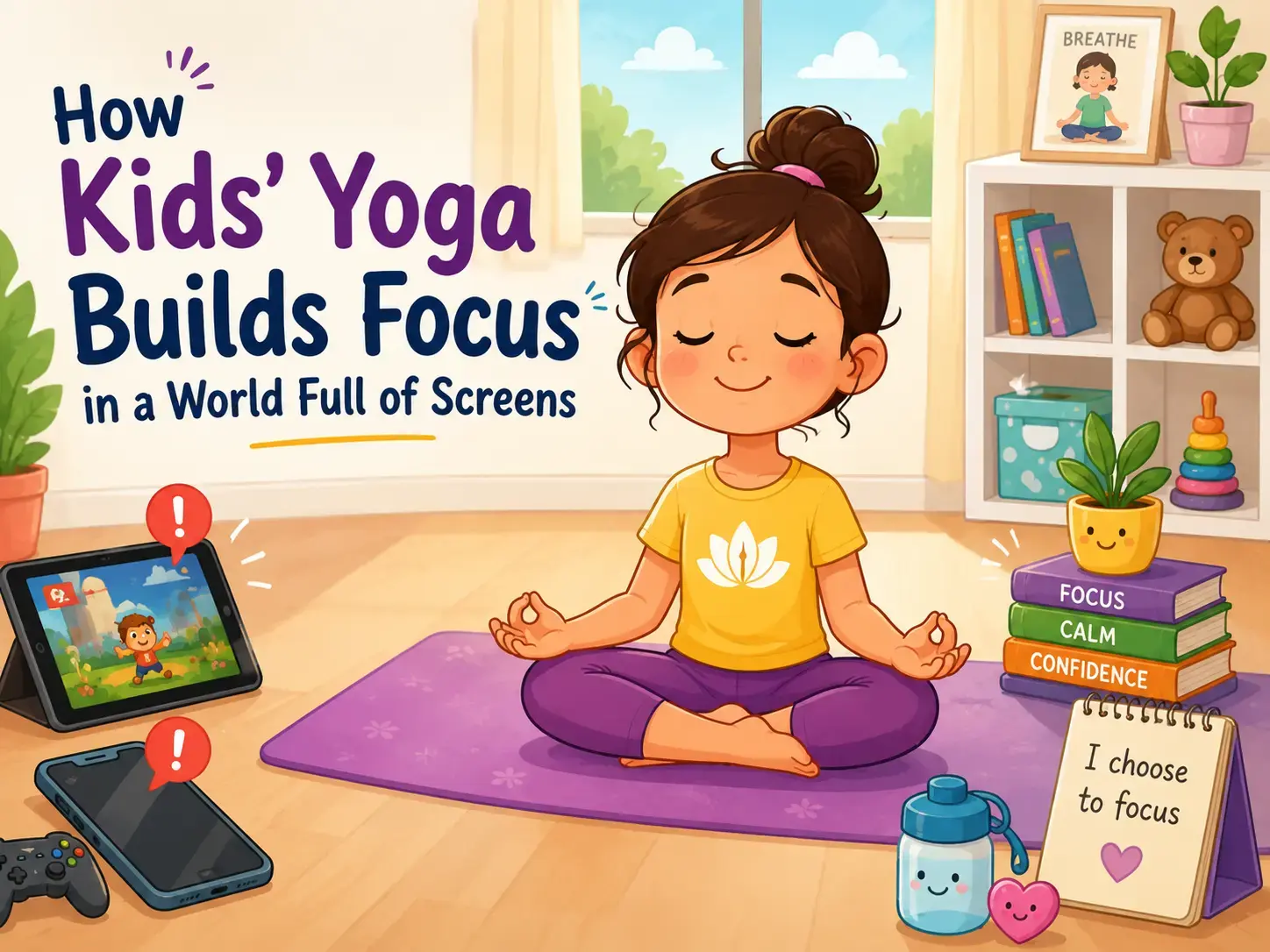
Kids’ yoga helps children build focus by combining movement, breath, and storytelling in a way that trains attention the same way academic skills are trained — through repetition and play. Unlike passive screen time, yoga engages the body and mind together, which research links to better concentration, calmer emotional regulation, and improved classroom behavior. For parents worried about screen exposure, structured “positive screen time” yoga sessions offer a rare middle ground: kids still get to watch something, but what they’re watching moves them, not just entertains them.
If you’ve ever tried to pull your child away from a screen only to be met with a meltdown, you’re not imagining the struggle. Attention spans in young children are being shaped by constant stimulation, and most parents don’t have a realistic alternative that a five-year-old will actually choose over a tablet. This is exactly the gap kids’ yoga fills — and it’s one of the fastest-growing conversations in early childhood wellness this year.
Why Focus Has Become the Real Conversation in Kids' Wellness
For a long time, kids’ fitness conversations centered on flexibility and physical activity alone. In 2026, the bigger concern educators and parents are raising is attention span — the ability to sit with one task, listen fully, and self-regulate without needing constant novelty. Preschools and educators nationwide have been highlighting this shift, using movement-based mindfulness specifically to strengthen concentration and emotional balance in early childhood, not just physical fitness.
That’s a meaningful shift. It means yoga for kids isn’t just a “nice to have” alongside sports or dance — it’s increasingly seen as a tool for the same skills that help with schoolwork, friendships, and emotional resilience.
How Yoga Actually Trains a Child's Attention
Yoga builds focus in kids through a few specific mechanisms, not magic:
Breath as an anchor
When a child learns to notice their breath, they’re practicing the exact skill they’ll need later to calm down before a test or a tantrum — pausing before reacting.
Story-driven sequences
Kids don’t sit still because they’re told to; they sit still because they’re following a jungle trail, exploring a story, or becoming an animal. Narrative-based yoga sessions hold attention far longer than instruction-only classes, because the child is following a plot, not a command.
Repetition without boredom
Unlike passive screen content, yoga asks the body to do something every few seconds — shift a pose, hold a breath, balance on one foot. That constant, gentle engagement is what actually builds sustained attention over time, pose by pose, session by session.
Making Screen Time Work For Focus, Not Against It
Most parents aren’t trying to eliminate screens entirely — that’s not realistic in 2026. The more useful goal is making screen time work for focus instead of against it. A themed, story-based online yoga class is fundamentally different from passive video content: the child is moving, breathing, and following along, not just watching.
This is the exact idea behind Yoga Guppy’s online courses — pre-recorded, story-driven yoga adventures like the Jungle Yoga Trail, Yoga Explorers, and Yoga Adventureland, built specifically so screen time becomes movement time instead of scroll time.
Getting Started at Home
You don’t need a studio or props to start building focus through yoga at home. A few starting points:
- Keep sessions short. Five to fifteen minutes is enough for younger children — long sessions backfire and lose attention rather than building it.
- Use a story, not just poses. “We’re crossing a jungle river” holds attention far better than “hold this pose for ten seconds.”
- Make it a routine, not a one-off. Focus is a trained skill, not a one-time fix — a few sessions a week compound over time.
- Match the format to your child’s age. A four-year-old and a ten-year-old need very different pacing and complexity, which is why age-banded classes matter.
If you’d rather have your child join a live, guided session instead of a self-paced course, Yoga Guppy’s classes are grouped by age — Little Yogis (4–6), Yoga Adventures (7–9), and Yoga for Tweens (10–12) — so the pacing and story complexity actually match where your child is developmentally.
Frequently Asked Questions
Q1; At what age can kids start yoga for focus-building?
Children as young as three or four can begin simple, playful yoga, though the format needs to be story- and game-based rather than instructional at that age. Structured age-banded classes work better than generic adult-style sessions.
Q2; How long should a kids' yoga session be to actually help with focus?
Ten to twenty minutes is typically enough for younger children, and up to 30–45 minutes for tweens. Consistency across the week matters more than session length.
Q3; Is online kids' yoga as effective as an in-person class?
Yes, provided the content is interactive and story-driven rather than passive. A guided, movement-based online session asks the child to participate continuously, which is very different from watching a video.
Q4; Can yoga help with kids who struggle to sit still or pay attention in school?
Yoga isn’t a replacement for professional evaluation if a child has ongoing attention difficulties, but many parents and educators report noticeable improvements in self-regulation and classroom focus with regular practice.
Q5; What's the difference between kids' yoga and adult yoga?
Kids’ yoga is shorter, more playful, and built around stories, games, and animal poses rather than precise alignment or meditation. The goal is engagement and joy first, with the physical and focus benefits following naturally.
Ready to turn screen time into mindful movement? Explore Yoga Guppy’s full course library or book a class matched to your child’s age group. And if you’re a parent looking for your own practice, Yogalates with Rashmi offers yoga-Pilates programs built for busy moms.