- Written by: Admin
- June 26, 2026
- Categories: School, Students
- Tags: , classroom yoga, kids yoga benefits, mindfulness for kids, yoga for kids, yoga improves concentration
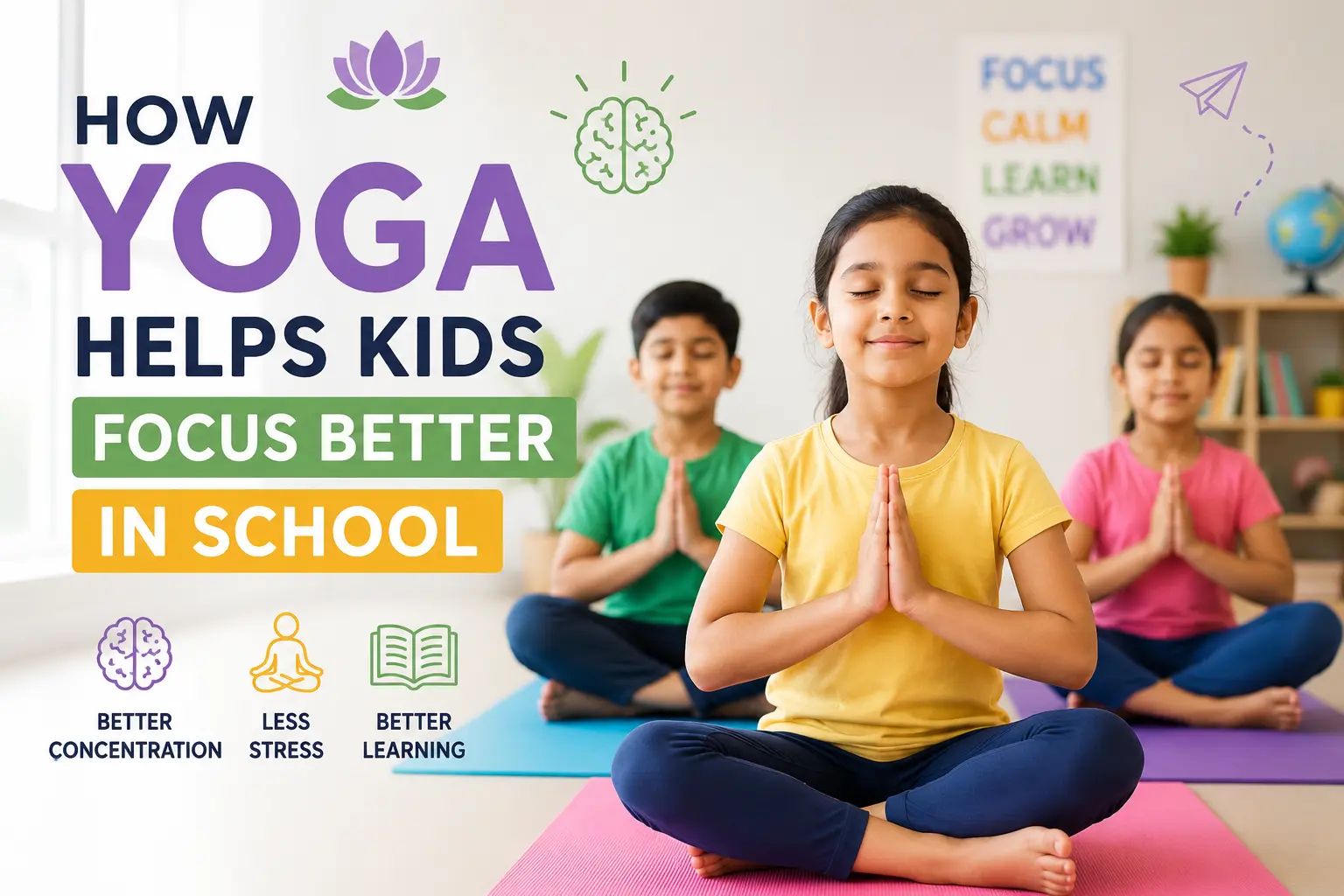
How Yoga Helps Kids Focus Better in School
It’s a Tuesday morning in Mumbai. Your child has barely touched breakfast, their school bag is half-packed, and their mind is already somewhere between a YouTube video they watched last night and the maths test they didn’t fully prepare for. Sound familiar?
For millions of parents across India — and around the world — children’s ability to concentrate has become one of the biggest everyday worries. Screen time is up, attention spans feel shorter, and the pressure of school keeps growing. But here’s something many parents are discovering: yoga might be one of the simplest, most effective tools to help.
Not the serious, sit-still-and-breathe kind. The kind that’s fun, story-driven, and genuinely exciting for a six-year-old. Let’s talk about how yoga for kids concentration actually works.
Why are kids struggling to focus in the first place?
Before jumping to solutions, it helps to understand what’s going on. Children today are processing more information before 9 AM than a child in the 1980s processed in an entire day. Notifications, reels, gaming, school deadlines — the nervous system simply hasn’t evolved fast enough to keep up.
The result? A brain that’s in a near-constant state of low-level stress. When that happens, the prefrontal cortex — the part responsible for attention, decision-making, and self-control — takes a backseat. Kids aren’t being difficult. Their brains are just overwhelmed.
What does yoga actually do to a child's brain?
This is where it gets genuinely interesting. Yoga isn’t just stretching. When children practice yoga — even 15 to 20 minutes a day — it does three specific things that directly improve their ability to focus:
1. It calms the nervous system
Yoga activates the parasympathetic nervous system — the body’s natural “rest and digest” mode. Breathing exercises like deep belly breathing lower cortisol (the stress hormone), which in turn allows the brain’s attention centres to function properly. A calm child is a focused child.
2. It strengthens the brain's attention muscles
Holding a yoga pose — even a simple tree pose or warrior pose — requires the same mental effort as paying attention in class. You have to notice when your mind wanders and bring it back. Over time, children who practise yoga regularly get measurably better at this, both on the mat and at the desk.
3. It builds body awareness
Children who are more aware of their bodies tend to fidget less, sit still longer, and transition more easily between activities. Yoga builds this proprioception naturally, without making kids feel like they’re being trained to behave.
What the research says
Studies from institutions including NIMHANS in Bengaluru have found that regular yoga practice helps children with attention difficulties — including those with ADHD — show marked improvement in self-regulation and focus. Schools across Indian cities like Pune, Hyderabad, and Delhi that have introduced structured yoga sessions report calmer classrooms and better academic engagement overall.
Globally, studies from the Journal of Attention Disorders and various mindfulness research bodies consistently show that even short daily yoga sessions — as brief as 10 minutes — lead to meaningful improvements in on-task behaviour in children aged 4 to 12.
Practical yoga moves that improve concentration in kids
You don’t need a yoga mat or a studio. Here are five poses that specifically build focus and are gentle enough for children as young as four:
- Tree Pose (Vrikshasana) — improves balance and single-pointed concentration.
- Eagle Pose (Garudasana) — demands focus and coordination; great for slightly older kids (7+).
- Cat-Cow Stretch — syncs breath with movement, immediately calming an agitated mind.
- Bee Breath (Bhramari Pranayama) — the humming vibration helps settle an overactive brain within minutes.
- Child’s Pose (Balasana) — a gentle reset between activities; signals the body to slow down and be present.
Tips for parents: building a routine that actually sticks
The biggest mistake parents make is treating yoga like homework — something the child has to sit through. Here’s what actually works:
- Start with just 10 minutes before school — even one focused session can shift the energy of an entire morning.
- Make it story-based — young children respond brilliantly when poses are wrapped in an adventure (“You’re a jungle explorer! Now become a tall tree!”).
- Do it with them — children model what they see. A parent doing tree pose alongside a four-year-old is infinitely more motivating than a screen instruction.
- Use online courses designed for kids — structured, age-appropriate sessions take the guesswork out of it and keep children genuinely engaged.
Conclusion
Yoga for kids concentration isn’t a magic trick — it’s a practice. But it’s one of the few practices that is genuinely enjoyable for children, requires no equipment, and has real, lasting benefits on how children learn and engage with the world around them.
Whether your child is four years old and full of restless energy, or ten and starting to feel the pressure of exams, yoga meets them exactly where they are. And once it becomes part of their daily routine, the focus, calm, and confidence it builds tends to follow them well beyond the yoga mat — and straight into the classroom.
FAQs
Q1. Can yoga improve a child's focus in school?
Yes. Regular yoga practice helps children improve focus by combining mindful breathing, movement, and relaxation techniques. These activities can increase attention span, reduce stress, and support better classroom learning.
Q2. What are the best yoga poses for improving concentration in kids?
Simple poses like Tree Pose, Mountain Pose, Child’s Pose, Butterfly Pose, and Cat-Cow Pose help improve balance, body awareness, and concentration while keeping children engaged.
Q3. How often should children practice yoga for better focus?
Children can benefit from practicing yoga for 15–20 minutes, three to five times per week. Consistent practice supports concentration, emotional regulation, and healthy physical development.Lorem ipsum dolor sit amet, consectetur adipiscing elit. Ut elit tellus, luctus nec ullamcorper mattis, pulvinar dapibus leo.
Q4. Does yoga help children with stress and anxiety at school?
Yes. Yoga encourages deep breathing and mindfulness, which help children manage stress, regulate emotions, and feel calmer and more confident in school and daily life.